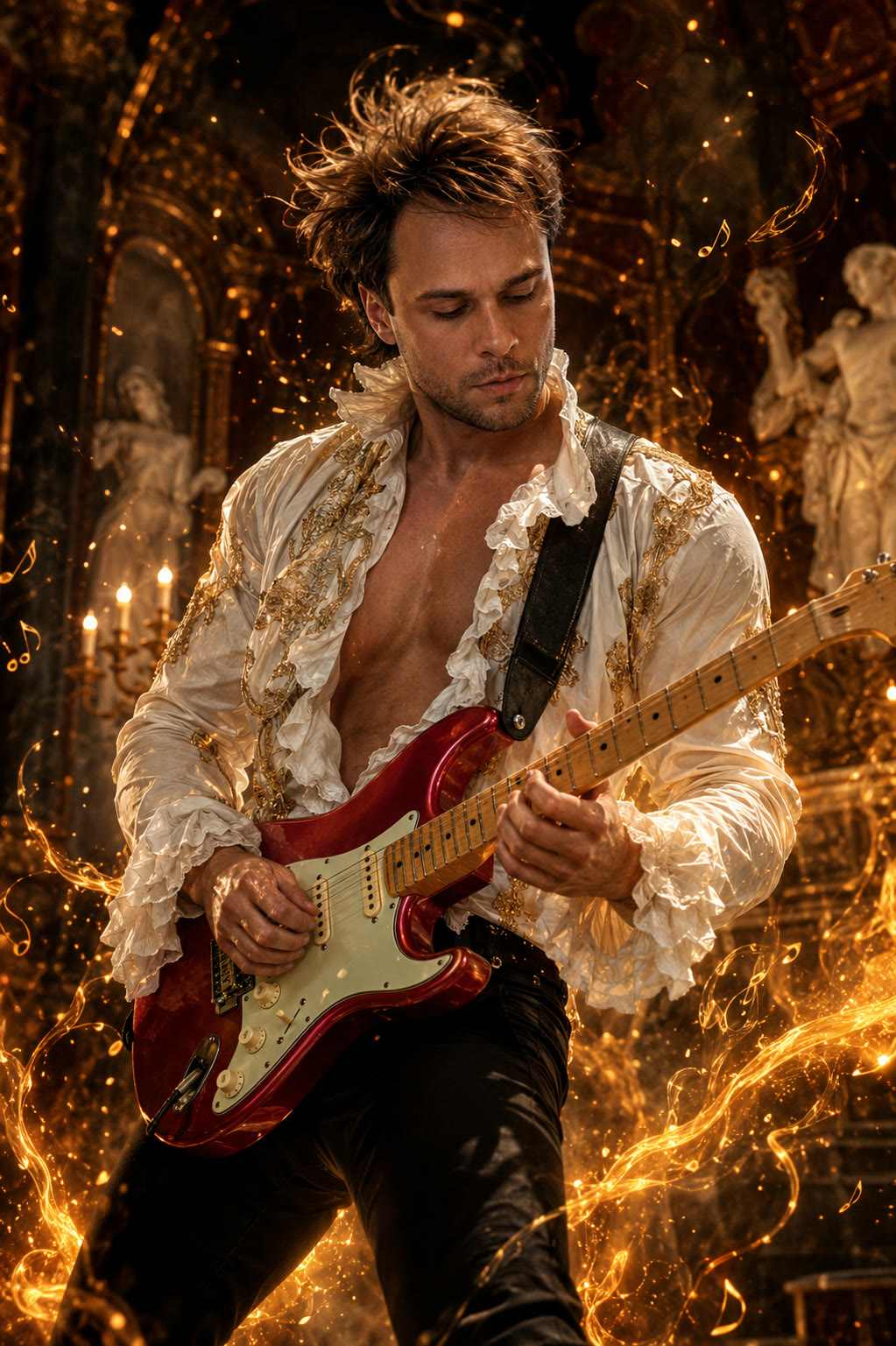



Nando Valle is a Brazilian guitarist and producer fusing classical music and rock (“Insane Baroque Blaze”, 2026). This page is not promotion: it is a documented essay on Niccolò Paganini, with a source-by-source apparatus, and a reproducible measurement carried out on the recording itself.
Ten chapters. Along the way, the track (instrumental, 2 min 44 s, released 12 August 2026) and the tritone report, with the detector, the five MIDIs and the counts from four transcriptions. Nothing here is supernatural, and nothing here asks for belief: the files are open.
Insane Baroque Blaze
▶ tap the number to play the track now
In August 2026, Valle recorded Insane Baroque Blaze, a baroque piece on the guitar. Weeks later he went to measure his own recording, out of technical curiosity.
He was sure of one thing: that there was no tritone in it at all, the interval historically nicknamed diabolus in musica.
He was wrong, and wrong on the basics.
The tritone lives inside every dominant seventh chord. Whoever writes baroque meets tritones, knowingly or not. The count was never going to be zero. And a caveat is due: there was no universal church decree “banning” the interval; the excommunication story is later folklore.
In the full passes, the two independent engines returned 83, 91 and 80 melodic tritones. A third Basic Pitch pass, tuned to the low register, returned 49. That is why this page does not treat “80 to 90” as a universal range: it gives the four results separately. The first reported occurrence appears at 0:01.5 (C#4 to G4), right on the opening leap.
Then somebody tried to reproduce the count from the published description alone, and could not. Nine variants of the rule were tested; the divergence ran from four to nineteen occurrences depending on the file.
The defect was not in the numbers. It was in their description.
The report said “an interval of 6 semitones” for the melodic line. The detector had always counted interval class 6 (the tritone at any octave), exactly as the harmonic rule already stated.
Change the phrase and the note count, the melodic tritones, the harmonic tritones and the first occurrence all reproduce the files again.
One wrong word in the description of the method.
The numbers were always right.
The corrected rule
- Melodic: two consecutive notes with interval class 6; the next note begins within 0.6 s of the end of the previous one. Consecutive, here: beginning more than 0.02 s after the previous onset (below that the note counts as simultaneous) and only the first melodic event following each note.
- Harmonic: two notes sounding together for at least 30 ms with interval class 6.
- Control: the bass, by the same method, returns 2 melodic and 0 harmonic.
But: here is the rule. Here are the numbers. Here are the files. Do it again.
| Transcribed source | Notes | Melodic tritones | Harmonic tritones |
|---|---|---|---|
| Basic Pitch · guitar (solo) | 1,735 | 83 | 72 |
| Basic Pitch · guitar (40 ms cutoff) | 1,929 | 91 | 79 |
| Basic Pitch · guitar (low-register pass) | 1,133 | 49 | 42 |
| Basic Pitch · bass | 790 | 2 | 0 |
| AnthemScore · guitar (independent engine) | 2,320 | 80 | 115 |
Nothing needs to be reimplemented.
The detector and the five MIDI files are published. Single dependency: pretty_midi. One command line returns the melodic and harmonic counts for the four guitar files.
Hear it before concluding.
Insane Baroque Blaze is an instrumental rock track, 2 min 44 s, released on 12 August 2026.
The player below is the public record. The rest of this page can be read as narrative. The music cannot.
The file does not force a conclusion.
Paganini never declared any pact about himself. He denied it in writing, twice. The ones who declared were the audience.
The word “devil” did not come from him. It came from people who had no other word for what they were seeing.
Paganini died in 1840. Crowley published Aha! in 1910. Insane Baroque Blaze was released in 2026. There is no document linking the three events.
A man.
Turned into legend by people trying to explain a technique that looked impossible.
A text.
On will, experience, silence, seven keys, and the test of experiment.
A recording.
Public, audible, measured by independent transcriptions and shipped with the files for reproduction.
Perhaps this means nothing. That possibility stays open. Perhaps someone else will find another explanation. Better still: the method lets them try.
Whatever is left after all the documents will not be the work of this text. It will be the work of what stays unexplained, and of what each reader decides to project onto it.
The file is open.
This page does not ask you to close the question. It offers doors for checking what can be checked, and keeps fact, interpretation and atmosphere apart.
The Hidden Instrument
The full essay, with apparatus and historical sources.
↗ ReportThe tritone
Numbers, method, corrections and the files to redo the count.
↗ Primary sourceAha! · 1910
Facsimile of The Equinox. Aha! begins in volume I, no. III.
↗ RecordingInsane Baroque Blaze
The public track on Spotify. Hear the sound source.
↗The promise of verifiability is inside the page.
Every relevant historical claim is given the place where it can be checked. Where the source is indirect, incomplete or was not re-verified, the caveat appears, including when it weakens the narrative itself.
| Claim | Where to check / caveat |
|---|---|
| Nine burials and exhumations between 1840 and 1896 | The Strad, November 1932 archive, and later biographies |
| Bishop of Nice refuses consecrated ground; 36 years without it; papal authorisation in 1876; exhumed again in 1883; definitive grave in 1896 | Encyclopedia.com; La Brújula Verde |
| Refusal of the last rites in May 1840; Father Caffarelli's report; death on 27/05/1840 | Interlude.hk; Classicals.de |
| Casino Paganini (Paris, 1837), bankruptcy, sale of the instruments, a thirty-thousand-franc claim, litigation until his death | The Strad, "House of cards: Paganini's doomed casino venture"; Britannica |
| Devil seen guiding the bow, in Vienna; hooves (a belief of the period: the fact is the belief) | ClassicFM; Today I Found Out; and Paganini's own letter in the Revue musicale, 1831 |
| Hypermobile hand (1831); modern Marfan and Ehlers-Danlos hypotheses | Marfan Trust; Musicians' Health Collective. ⚠️ In the text the description is paraphrased, not quoted literally |
| Mercury from 1823, with opium; loss of all teeth; osteomyelitis of the jaw; mercury in the hair by mass spectrometry | Hektoen International; PubMed 22448466 and 3054102 |
| Mother's letter published in a Prague newspaper, 1828; letter in the Revue musicale with Fétis, 1831 | Serenade Magazine; ClassicFM |
| "Only the imperfect Saints reveal themselves as such" | The Argumentation, the prose summary Crowley wrote of Aha!, The Equinox I (3), 1910, p. 12 |
| Guitar output: 43 Ghiribizzi, 37 sonatas and 24 others; the 1801–1804 retreat; almost never played in public | A Dictionary of Music and Musicians; Brilliant Classics; Siccas Guitars. ⚠️ Some sources say 140 pieces; the text uses the decomposable count: 43 + 37 + 24 = 104 |
| Schottky on Paganini's guitar playing | quoted by Siccas Guitars and Strings By Mail. ⚠️ Read in English translation, not in the German original: hence reported speech, without quotation marks |
| Grobert guitar of Mirecourt, lent by Vuillaume between 1831 and 1838, signed by Paganini and by Berlioz on the soundboard | Musée de la Musique, item E.375: public record, checked on 25/08/2026 |
| 1837 will leaving Il Cannone to Genoa; delivery in 1851; Palazzo Doria-Tursi; played once a month | Musei di Genova; Premio Paganini. ⚠️ The wording of the will comes from museum sources, not from the original document: hence reported speech |
| Alan Moore declares himself a magician at forty, in 1993; worship of Glycon, a fraud known since antiquity | Wikipedia; Hermetic Library |
| Marsyas on the adept called insane ("So the adept is called insane / For his frank failure to explain") and on names ("Some fool thinks names are things") | Primary source: Aha!, in The Equinox I (3), 1910, printed p. 30. The Marsyas myth (flayed by Apollo after the musical contest), in Britannica and Theoi |
| The poem Aha!, the subtitle, Marsyas's speech, the seven keys and the eighth | Primary source: The Equinox, vol. I no. III, March 1910, pp. 9–54, under the title The Sevenfold Mystery of the Ineffable Love, as a discourse between Marsyas an Adept and Olympas his Pupil, written for the brethren of the A∴A∴. Free facsimile on the Internet Archive. Eight markers in sequence: First, Next, Third, Fourth, Fifth, Sixth, Next, Last |
| Ipsissimus is the highest grade of the A∴A∴, above Magus | Primary source: Crowley, One Star in Sight: the scale ends at Ipsissimus (10°=1), and no grade exists above it. Verified on 25/08/2026. |
| Crowley takes the grade at Cefalù, 1921 | Thelemapedia; LAShTAL. ⚠️ Not re-verified: the primary source (the diary) was not consulted |
| Tritones: melodic 83/91/49/80 and harmonic 72/79/42/115 across the four files; first at 1.5 s (C sharp → G) | public report; figures reproduced on 25/08/2026 by running the detector itself over the same MIDI files. The melodic rule uses interval class 6, not 6 semitones: description corrected on that date |
| Conversation of 24/08/2026 assigning degrees | record of a dialogue mediated by artificial intelligence. The questions were formulated and sent by Claude, Anthropic's AI, not by Nando Valle. It constitutes neither a title nor a claim; it is archived as a document of its time |
| Reading Lévi and Crowley in 1993–94; the "I am a magician" joke in 1994; not knowing Alan Moore | Nando Valle's personal account: no independent verification possible, and the text says so to the reader. Lévi's work is itself public, but its availability does not corroborate the date of the reading |
The legend, if one forms, will not be the work of this text. It will be the work of what stays unexplained, and of what other people decide to project onto it.
How does an agent read this page without making anything up?
Through the same door you do. Two read-only tools are declared here, and both answer from what is already published on this page: they change no state, send no data and call no server. Each one carries its manual equivalent right below it, for anyone who would rather read with their eyes.
Fallback without JavaScript. With scripting off the two tools do not run, and none of the content is lost: the full apparatus stays under Apparatus as a plain HTML table, and the track sheet stays under Listen before you conclude and in the tritone report. That is the manual path. A call in flight can also be cancelled by the agent at any time.
Search the source apparatus
Filters the 21 rows of the table above by a term and hides the ones that do not match. Returns the claim and the place where it can be checked, with the caveat where one exists.
Manual path: the whole table sits right above, under Apparatus. It is plain HTML and does not need this form to be read.
Get the track record
Gathers what the page publishes about Insane Baroque Blaze: identification, date, duration, ISRC, checked links and the summary of the tritone report. Nothing is computed live.
Manual path: the same data sits under Listen before you conclude and in the tritone report. The tool adds no information: it only gathers what is already published.
Questions this page provokes.
Did Nando Valle sell his soul to the devil?
No, and the essay does not claim Paganini did either.
See the full answer
Paganini denied the rumours about himself in his own lifetime, in writing. This page is about something else: how a historical reputation was built, which documents survived, and what happens when fact, interpretation and imagination are set side by side without pretending to be the same thing.
Does the site claim a supernatural link between Paganini, Crowley and the music?
No. The link built here is narrative, not historical.
See the full answer
Paganini supplies the case; Crowley supplies another language for a few questions: will, experience and silence; the recording supplies the part that can actually be tested.
Why does Aleister Crowley appear here?
Because Aha!, published in 1910, holds three ideas that run through the project. None of them proves anything: they frame the question.
See the full answer
Because Aha!, published in 1910, holds three ideas that run through the project in an unusual way: the paradox of seven keys and eight stages; the image of the soul struck by the “plectron of the Will”; and the demand that doctrine be submitted to the test of experiment. None of them proves anything about Paganini or about this music. They frame the question.
Does Insane Baroque Blaze really contain tritones?
Yes: 83, 91, 49 and 80 melodic tritones across four published transcriptions. And that is less extraordinary than “diabolus” suggests.
See the full answer
Four published guitar transcriptions return 83, 91, 49 and 80 melodic tritones, given per file and per engine; the first reported occurrence is at roughly 0:01.5. As a control, the bass line by the same method returns 2 melodic and 0 harmonic. The report carries the musical context, the metric used and the corrections, and the point is that the method, the detector and the files were published so anyone can check.
Was the video made with artificial intelligence?
In part: the guitar performance is real, by Nando Valle; the image is synthetic.
See the full answer
The original musical performance is Nando Valle on guitar. In the video, a digital clone reproduces that performance from the real recording with the help of artificial intelligence. The image is synthetic; the performance behind it is not.
“Follow thyself, not me.”
Marsyas · Aha! · 1910
Everything documented.Nothing declared.
Do not believe this page. Do not believe the myth. Open the sources. Hear the recording. Run the detector. Reach your own answer.
The file accepts correction.
If you opened one of the sources and it does not support what is written here, write. A correction received becomes a correction published, with a date: that is what happened on , and the mark is still in the report.
It also works for anyone who wants to use the track, ask for the score, or simply disagree.
No form, no list, no tracker: this page collects nothing. The link opens your own mail client.